Tilt-Head vs Bowl-Lift Stand Mixers: Which Is Better? (October 2026)
In a tilt head vs bowl lift stand mixer comparison, choose tilt-head for easy bowl access or bowl-lift for frequent heavy batches. Match the bowl to your usual recipe size, then check cabinet clearance and how you'll remove it.
On this page (12 sections)
- Tilt-head vs bowl-lift stand mixer: what is the main difference?
- Which bowl size matches the batches you actually make?
- Who should buy the KitchenAid Artisan KSM150PS?
- Who should buy the KitchenAid 5.5-Qt Bowl-Lift?
- Who should buy the KitchenAid 7-Qt Bowl-Lift?
- Is bowl-lift better for bread dough?
- How much counter and cabinet space do they need?
- What do the speeds and included tools change?
- How should you set up and care for either design?
- Which common mistakes should you avoid?
- Where can you find model-specific operating limits?
- Tilt-head vs bowl-lift stand mixer: make the final choice
Choose a tilt-head mixer for easier bowl access and a bowl-lift mixer for frequent heavy or larger batches. Your tilt head vs bowl lift stand mixer decision should start with the recipes you repeat each week, followed by counter space and bowl handling.
The KitchenAid Artisan suits bakers who often stop to scrape, add ingredients or change tools. The 2 bowl-lift options suit those who want a locking bowl, with a choice between moderate and larger batch capacity.
A larger mixer makes sense when it saves you from regularly splitting recipes. For occasional big baking days, making 2 batches may be easier than storing more mixer than you usually need.

Tilt-head vs bowl-lift stand mixer: what is the main difference?
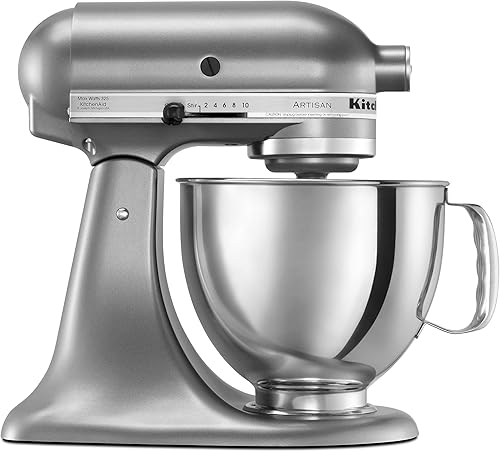
A tilt-head mixer moves the motor head away from the bowl; a bowl-lift mixer raises the bowl toward a fixed head. That changes your access during a recipe and the space needed around the machine.
With a tilt-head design, you stop the mixer and raise the head to reach ingredients or remove a tool. The open space above the bowl helps when scraping thick batter from the beater.
With a bowl-lift design, you lower the bowl to create working space beneath the head. Removing the bowl and tool takes a different sequence, so learning that motion is part of getting comfortable with the mixer.
The compared bowl-lift models use a 3-point locking bowl, which KitchenAid says provides stability for heavy, dense ingredients. Choose that structure because it suits your mixing routine, rather than assuming every recipe needs it.
Tilt-head vs bowl-lift access during a recipe
Tilt-head access is the better fit for frequent stops to scrape, check texture or add ingredients by hand. Moving the head away gives you a clearer path into the bowl.
Bowl-lift access can suit recipes that spend longer mixing between additions. The fixed head stays above the bowl, so plan where your measuring cups and spatula will enter.
Neither design means you can leave the machine running while reaching inside. Stop it before scraping, and unplug it before fitting or removing tools.
Which bowl size matches the batches you actually make?
Choose capacity for your normal recipe, with room for ingredients to move during mixing. Bowl volume isn't the same as a safe dough limit, and different doughs place different loads on a mixer.
The Artisan holds 5 qt, the smaller bowl-lift holds 5.5 qt, and the larger bowl-lift holds 7 qt. The first step up is modest; the larger bowl makes a clearer difference for repeated batch baking.
KitchenAid gives cookie examples of 9 dozen, 11 dozen and 13 dozen, respectively. Those examples use a flat beater and 28 g dough portions, so they aren't a promise for every cookie recipe.
Compare those examples with how you bake. A stiff dough with lots of mix-ins needs a different judgment from a soft cake batter, even if both occupy a similar amount of bowl space.
Small recipes deserve attention too. Ingredients must reach the tool properly, so check minimum quantities in the manual if you often whip a little cream or make a small batch of frosting.
Our stand mixer size guide explains how to match capacity to recipes. For a broader comparison of mixer types and uses, start with the complete stand mixer buying guide.
When is splitting a recipe the better choice?
Split occasional oversized recipes if your everyday mixer otherwise suits you. An annual holiday bake doesn't have to decide the size of the appliance on your counter all year.
Remember that a larger mixing batch also needs somewhere to go. Check oven space, baking sheets, cooling racks and freezer room before choosing a mixer mainly to increase output.
Who should buy the KitchenAid Artisan KSM150PS?
Buy the Artisan if easy access matters during ordinary home baking. It suits someone who makes cakes, cookies and occasional bread, especially when recipes involve several additions and scraping steps.
The tilting head helps you see and reach the bowl between stages. That makes it a sensible choice if you like checking batter texture rather than working through long mixing stretches.
Skip it if your regular recipes already push a bowl of this size or heavy dough is the main reason you're buying a mixer. More capacity and a locking bowl are stronger reasons to choose a bowl-lift model.
Also skip this setup if you can't give the head room to open where the mixer will sit. A shorter closed body doesn't help if you must move it every time you scrape.
For more detail on this model's fit, read our KitchenAid Artisan KSM150PS review.
Who should buy the KitchenAid 5.5-Qt Bowl-Lift?
Choose the smaller bowl-lift if bread dough is a regular job and you want a locking bowl without the largest capacity here. Its main appeal over the Artisan is the working setup, not a huge increase in bowl volume.
It suits a baker who wants to mix dense ingredients often but rarely needs oversized batches. KitchenAid says it can knead over 7 lb of bread; follow the manual's recipe-specific limits before planning around that amount.
Skip it if you want open access above the bowl more than you want the lift mechanism. It also isn't the space-saving bowl-lift choice, since its stated outer dimensions match the larger model.
If your regular recipes need substantially more bowl room, move up rather than expecting a small capacity increase to solve the problem. Start with your current recipe quantities, not the size of the household alone.
Who should buy the KitchenAid 7-Qt Bowl-Lift?
Choose the larger bowl-lift if batch baking is part of your routine, rather than an occasional event. It makes the most sense when extra bowl space helps you finish regular prep in fewer rounds.
KitchenAid says it can knead over 8.5 lb of bread. As with the smaller model, use the manual to match the dough type, quantity and speed before scaling a recipe.
Skip it if you mostly make small desserts or would need to carry it from storage for every use. The body weighs 28 lb, so decide where it will live and how you'll move it before buying.
Its larger bowl doesn't require more counter footprint than the smaller bowl-lift model here. That makes the choice between them more about batch needs, bowl handling and accessories than saving counter area.
Read the 7-qt KitchenAid bowl-lift review if this capacity matches your normal baking.
Is bowl-lift better for bread dough?
Choose bowl-lift for frequent heavy dough work, while the Artisan remains an option for bread within its instructions. Dough quantity and stiffness matter more than simply calling a recipe “bread.”
A soft enriched dough and a firm, low-moisture dough can put different demands on the machine. Don't assume a batch is suitable just because it fits inside the bowl.
KitchenAid says both bowl-lift models deliver twice the power in the bowl compared with the KSM150, measured as peak horsepower above speed 2. This specific comparison doesn't change the kneading speed you should use.
Follow the recommended dough speed, and let the recipe's texture guide the endpoint rather than running the mixer for extra time by habit. Stop if the machine moves, struggles or behaves unusually, then check setup and batch size.
Our guide to using a stand mixer for bread dough covers capacity concerns. For the mixing process, see how to knead dough with a stand mixer.
How much counter and cabinet space do they need?
The Artisan needs less width and closed height, but it also needs space for the head to open. Both bowl-lift models are taller and wider, with identical stated outer dimensions.
The Artisan measures 14.1 in deep, 8.7 in wide and 13.9 in high. Each bowl-lift model measures 14.63 in deep, 11.31 in wide and 16.5 in high.
Measure the intended work area, not just the storage spot. Leave room to reach controls, pour from a measuring cup and lift out a bowl without bumping a cabinet.
For tilt-head use, check the raised-head clearance rather than guessing from the closed height. For bowl-lift use, think through removing the tool and bowl beneath the fixed head.
Set the mixer on a stable, level counter with room around it. Keep it away from the edge, and make sure the cord reaches the outlet without crossing your main prep area.
What do the speeds and included tools change?
Choose tools around your recipes, and treat speed settings as controls for specific steps. An extra speed doesn't make the mixer the better choice for every baker.
The Artisan has 10 speeds, from slow stirring to fast whipping, and includes a pouring shield. Both bowl-lift models have 11 speeds, including a half-speed setting designed for folding delicate ingredients.
The smaller bowl-lift includes a stainless steel bowl, coated flat beater, coated dough hook and 6-wire whip. The larger model includes a stainless steel bowl, double flex edge beater, coated flat beater, coated dough hook, 11-wire whip and pouring shield.
The double flex edge beater has 2 flexible edges designed to scrape the bowl during mixing. You should still stop and check for unmixed ingredients rather than assuming any beater removes every need for scraping.
Use a flat beater for mixtures such as cookie dough, a hook for suitable yeast dough and a whip for aerating mixtures. Delicate folding may still be better finished by hand when preserving air matters most.
KitchenAid offers more than 10 optional hub-powered attachments for these mixers, sold separately. Read whether KitchenAid mixer attachments are universal before buying, especially because hub attachments and bowl tools need different compatibility checks.
How should you set up and care for either design?
Fit the bowl and tool correctly before adding ingredients, then check clearance according to the manual. Poor setup can leave ingredients unmixed or let the tool strike the bowl.
For a tilt-head mixer, secure the bowl and lock the head in its working position as directed. For a bowl-lift mixer, seat every bowl connection correctly and raise the bowl fully before mixing.
If the beater misses ingredients or contacts the bowl, stop and check the model's adjustment steps. Our guide to adjusting KitchenAid beater height explains why clearance matters.
After use, unplug the mixer, remove the tool and bowl, and wipe the body with a damp cloth. Don't immerse the motor housing, and remove food from tool connections before it dries.
Cleaning instructions can differ between coated tools, wire whips and bowls. Check each piece before using a dishwasher; our KitchenAid attachment dishwasher guide helps you sort them.
Which common mistakes should you avoid?
Avoid overfilling, starting too fast and buying for a rare recipe. These mistakes can make either design harder to use than it needs to be.
Start slowly when adding flour or other dry ingredients, then increase speed as the recipe directs. A pouring shield helps contain additions, but it doesn't replace a sensible starting speed.
Don't force a thick mixture to move by turning the speed higher. Stop, check the recommended load and divide the batch if needed.
Keep spatulas, fingers and measuring utensils clear of moving tools. Stop the mixer before scraping, and unplug it before removing a tool or clearing a jam.
Finally, don't choose on bowl capacity alone. Handling a filled bowl, washing it in your sink and storing the accessories are part of every baking session.
Where can you find model-specific operating limits?
Use the exact model's manual for dough limits, speed guidance, tool care and setup. General advice can't replace instructions for the mixer and accessory you're using.
The KitchenAid manuals and literature page is the place to find that guidance. Check it before planning a larger batch or changing beater clearance.
Tilt-head vs bowl-lift stand mixer: make the final choice
Choose the Artisan for frequent bowl access, the smaller bowl-lift for regular dough work, or the larger bowl-lift for repeated large batches. In a tilt head vs bowl lift stand mixer decision, your usual recipe and working space should settle the choice.
Before ordering, write down your normal batch size and measure the counter where you'll actually mix. If you still need to compare other KitchenAid options, use our KitchenAid model comparison to narrow the choice.
Frequently asked questions
Is a tilt-head or bowl-lift mixer better?
Choose tilt-head for easy access during regular home baking and bowl-lift for frequent heavy or larger batches. Neither design replaces the need to match capacity to your recipes; check the space needed to raise the head or remove the bowl before deciding which setup suits your counter.
Is a bowl-lift mixer more powerful?
KitchenAid says these bowl-lift models deliver twice the power in the bowl compared with the KSM150, measured as peak horsepower above speed 2. That doesn't mean you should knead faster; follow each model's dough-speed and batch limits rather than treating the power comparison as permission to increase either.
Can you make bread dough in a tilt-head mixer?
Yes, the Artisan can knead bread dough when you follow its instructions for speed, batch size and use. A bowl-lift model becomes more appealing as heavy dough work becomes routine; read our guide to kneading dough with a stand mixer before changing the size of your usual recipe.
Does a bowl-lift mixer take up more space?
Both bowl-lift models here are wider and taller than the Artisan, and they share the same stated dimensions. The Artisan still needs extra clearance with its head raised; measure working space for ingredients, controls and bowl removal rather than judging fit from the closed height alone.
Which KitchenAid mixer should I buy?
Choose the Artisan for convenient access, the smaller bowl-lift for regular dough work, or the larger bowl-lift for frequent batch baking. Decide from the recipes you repeat most often, then measure your counter; our KitchenAid mixer chooser helps you compare other models if none of these fits.