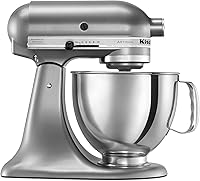
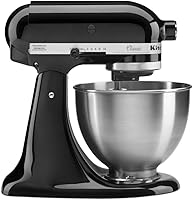
KitchenAid Artisan vs Bowl Lift Stand Mixer: Which Is Better? (October 2026)
For KitchenAid Artisan vs Bowl-Lift, choose the Artisan for everyday baking and easier bowl access. Choose the 7-quart Bowl-Lift for frequent large batches, provided you have space to keep it within reach.
On this page (11 sections)
- KitchenAid Artisan vs Bowl-Lift: what is the main difference?
- Which mixer has enough capacity for your recipes?
- Which model takes up less counter space?
- Does the Bowl-Lift's extra speed matter?
- What tools and attachments should affect your choice?
- Which KitchenAid mixer suits your baking routine?
- How should you set up either mixer?
- Can either mixer handle bread dough?
- What mistakes should you avoid with either mixer?
- How do you care for the bowl and tools?
- Which one should you choose?
Choose the Artisan for everyday baking and easy bowl access; choose the 7-quart Bowl-Lift for frequent large batches. The KitchenAid Artisan vs Bowl-Lift decision starts with your usual recipe size and the space where you'll actually use the mixer.
Here, Bowl-Lift means the KSM70SKXX, rather than every KitchenAid mixer with that design. Its extra bowl space and included tools help most when you regularly bake in quantity.
A bigger mixer isn't an automatic upgrade for a smaller recipe. Start with the cakes, cookies and dough you make most weeks, then decide which design makes those jobs easier.

KitchenAid Artisan vs Bowl-Lift: what is the main difference?
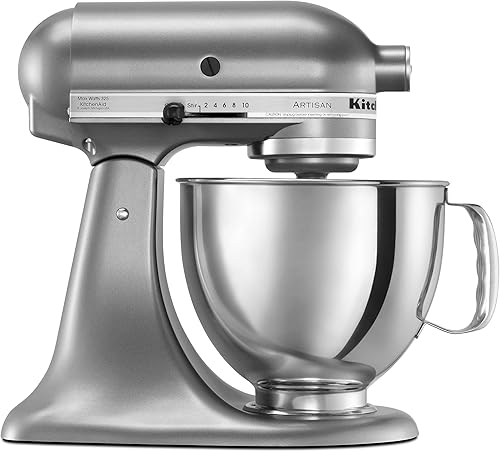
The Artisan raises its head for access, while the Bowl-Lift raises its bowl into a fixed mixing head. That changes how you add ingredients, scrape the bowl and remove a finished mixture.
With the Artisan, stopping the mixer and tilting the head back opens the space above the bowl. This suits recipes with several additions or frequent checks, such as adding flour in stages or scraping butter from the bowl walls.
The Bowl-Lift uses a 3-point locking bowl. KitchenAid says this supports stability when mixing heavy, dense ingredients.
You lower that bowl to create working room beneath the attachment. Before buying, consider how comfortable you'll be reaching around a tool to scrape, then removing the tool when you need more clearance.
For the broader design choice, read our guide to tilt-head vs bowl-lift stand mixers. These 2 models combine that design difference with different capacities, so they aren't a comparison of head movement alone.
Which mixer has enough capacity for your recipes?
The 5-quart Artisan suits everyday batches, while the 7-quart Bowl-Lift gives frequent batch bakers more room. Choose for the largest recipe you make regularly, rather than a holiday project you tackle once a year.
KitchenAid gives cookie capacities of 9 dozen for the Artisan and 13 dozen for the Bowl-Lift. Both figures use a flat beater and 28 g dough portions, so they provide a useful shared reference.
Those counts don't mean every cookie recipe fits in those amounts. A stiff dough, a loose batter and a mixture full of nuts place different demands on the mixer.
KitchenAid also gives the Bowl-Lift capacities of over 8.5 lb of bread dough and over 7.5 lb of mashed potatoes. Treat those as task-specific capacity claims, and follow the manual's limits for your recipe.
Before choosing, write down your usual batch, how often you double it and whether splitting it causes a real problem. Mixing cookies in 2 batches occasionally may be easier than storing a larger machine all year.
A larger bowl also isn't automatically better for tiny mixtures. The attachment needs enough mixture to engage it, so check minimum quantities if single egg whites or small frosting portions are a main use.
Our guide to what size stand mixer you need helps connect bowl size with your routine. The broader stand mixer guide for home bakers explains where capacity fits alongside tools, storage and recipe choice.
Which model takes up less counter space?
The Artisan needs less storage space, but you must allow room above it when the head is raised. Measure both the parked position and the space needed to work.
| Measurement | Artisan KSM150PS | Bowl-Lift KSM70SKXX |
|---|---|---|
| Depth | 14.1 in | 14.63 in |
| Width | 8.7 in | 11.31 in |
| Height | 13.9 in | 16.5 in |
| Weight | About 22 lb | 28 lb |
Under a cabinet, the Artisan's closed height doesn't tell you whether the head can open fully. You may need to pull it forward before mixing, so leave a clear path on the counter.
The Bowl-Lift's head stays in place, but you'll still need room to pour ingredients and remove the bowl. A machine that fits under a cabinet can remain awkward to use there.
Mark each footprint with paper before ordering. Set a mixing bowl, flour container and cooling rack nearby to see whether enough preparation space remains.
If the mixer will live in a cupboard, think through each lift from storage to counter. Both are substantial machines, and the larger model makes the most sense when you can keep it within easy reach.
Does the Bowl-Lift's extra speed matter?
The 1/2 speed matters most for delicate folding, rather than ordinary mixing. The Bowl-Lift has 11 settings including that slow option, while the Artisan has 10 speeds from a very slow stir to a fast whip.
KitchenAid designed the folding setting for additions such as blueberries and egg whites. It gives you a slower mechanical option when you want to combine ingredients gently.
You still need to watch the mixture and stop promptly. For a recipe that calls for careful hand folding, a spatula gives you control over each stroke and lets you check the bottom of the bowl.
For either mixer, start slowly when adding flour or liquid to reduce splashes and flour clouds. Increase speed only when the ingredients and recipe call for it.
Don't choose the larger model just because it has another setting. If you mostly cream butter, mix cake batter and whip cream, access and batch size are more useful deciding factors.
Our step-by-step KitchenAid mixer guide explains how to approach common tasks. Use the model's manual for speed limits, especially with dough.
What tools and attachments should affect your choice?
The Bowl-Lift's included tool set is useful for varied batch baking, while optional hub attachments should be a separate decision. Buy around the mixing work you'll do first.
The KSM70SKXX includes a stainless steel bowl, double flex edge beater, coated flat beater, coated dough hook, 11-wire whip and pouring shield. The Artisan includes a pouring shield too.
The double flex edge beater has 2 flexible edges designed to scrape the bowl during mixing. That can help incorporate ingredients along the sides, but you should still stop and check for unmixed pockets.
Match the tool to the mixture: a flat beater generally handles batters and cookie dough, a dough hook kneads, and a whip incorporates air. A tool that fits physically still needs to be appropriate for the task.
Both mixers support optional hub-powered attachments, including options beyond baking. KitchenAid offers more than 10 for each, sold separately.
Bowl tools and front-hub attachments aren't the same type of accessory. If you're bringing tools from another mixer, check the exact fit using our guide to whether KitchenAid mixer attachments are universal.
Which KitchenAid mixer suits your baking routine?
Choose the Artisan when access and everyday portions lead your decision. Choose the Bowl-Lift when larger batches are a regular need, rather than an occasional ambition.
When does the KitchenAid Artisan make more sense than the Bowl-Lift?
The Artisan makes sense for a baker who alternates between cookies, cakes and frosting in ordinary household batches. Its tilt head makes the stop, scrape and add routine straightforward.
It's also the stronger fit when your counter serves several jobs. The narrower frame leaves more room beside the mixer for weighing ingredients or working with dough.
Skip it if you regularly divide recipes solely because you need more mixing capacity. Also reconsider it if low cabinets prevent you from opening the head in a comfortable working spot.
If you're deciding between tilt-head models, see KitchenAid Classic vs Artisan. Our Artisan KSM150PS review covers this model in more detail.
When is the 7-quart Bowl-Lift the better fit?
The Bowl-Lift suits bakers who often prepare several trays of cookies, large quantities of dough or food for gatherings. Its larger working bowl helps when splitting those jobs has become a routine burden.
It also suits someone who will use the supplied tools across different recipes. The folding option and flexible-edge beater are more valuable when they solve jobs you already do.
Skip it if most recipes are small, storage requires awkward lifting or the larger footprint crowds your preparation area. Buying for imagined future batches can leave you handling a bigger machine without using its main benefit.
Read our 7-quart Bowl-Lift review if this describes your routine. Confirm that your regular recipes justify the space before choosing.
How should you set up either mixer?
Secure the bowl and attachment before mixing, then check that the tool clears the bowl correctly. Good setup prevents poor ingredient pickup and unnecessary contact between parts.
Place the mixer on a level, stable surface with enough room to work. Keep the cord away from heat, water and the counter edge.
With power disconnected, seat the bowl and fit the correct tool according to the manual. Lock the Artisan's head for operation, or fully secure and raise the Bowl-Lift's bowl into its mixing position.
A beater that sits too high can leave ingredients at the bottom; one that sits too low can strike the bowl. Follow our guide to adjusting KitchenAid beater height alongside your model's instructions.
Check clearance with the appropriate tool and method specified in the manual. Don't assume that an adjustment method for one mixer style applies unchanged to the other.
For the first recipe, use a familiar batch within the recommended limits. That makes it easier to notice an unsecured bowl, poor clearance or an unsuitable tool before adding more ingredients.
Can either mixer handle bread dough?
Both can knead dough within their model-specific limits, but bowl size alone doesn't establish a safe dough load. Recipe stiffness matters as much as the amount.
A firm, low-moisture dough resists the hook differently from a softer dough. Leave room for movement and use the manual's guidance for quantity, speed and run time.
Don't turn up the speed to force a dough that is resisting the mixer. Stop and reassess the batch and recipe instead.
Watch the dough's texture rather than relying only on elapsed minutes. Flour absorption, room conditions and the recipe can change how quickly dough develops.
Our guide to kneading dough with a stand mixer explains the process. If bread is your main reason to buy, judge the mixer against your most frequent dough recipe.
What mistakes should you avoid with either mixer?
Avoid overfilling, mixing too long and scraping while the tool moves. These habits matter more to everyday results than collecting extra settings or accessories.
- Stop before scraping. Switch off and disconnect power before putting a spatula near the attachment or changing tools.
- Add dry ingredients gradually. A pouring shield helps contain mess, but it doesn't make fast additions sensible.
- Check the bottom of the bowl. A smooth surface can hide flour or butter below the mixture.
- Stop at the recipe's endpoint. More mixing can toughen some batters or take whipped mixtures past the texture you want.
Don't leave a new recipe unattended while you do another kitchen job. Check how the mixture moves, particularly after adding flour or when working near a recommended capacity limit.
How do you care for the bowl and tools?
Clean parts promptly and follow the care instructions for each tool. Don't assume everything that detaches from the mixer belongs in the dishwasher.
Disconnect power before cleaning the mixer body, then wipe it with a damp cloth and dry it. Keep the base out of water and remove food from crevices before it hardens.
Coated tools, whips and bowls can have different care requirements. Our guide to putting KitchenAid attachments in the dishwasher explains what to check.
Dry tools before storage, and avoid piling heavy items against coated surfaces. If a tool starts striking the bowl or leaving an unusual amount unmixed, check seating and clearance before the next batch.
Which one should you choose?
For KitchenAid Artisan vs Bowl-Lift, choose the Artisan if your normal recipes fit comfortably and you value open bowl access. Choose the Bowl-Lift if frequent larger batches justify its size and you have a convenient place to use it.
Before ordering, check 3 things: your most common recipe, the manual's limits for that mixture and the working space on your counter. These checks are more useful than buying the biggest bowl you can fit.
If neither choice feels clear, use our guide to which KitchenAid mixer you should buy. Start with the job you need done every week, then choose the model that fits it.
Sources
Frequently asked questions
Is the KitchenAid Artisan or 7-quart Bowl-Lift better?
The Artisan is the better fit for everyday recipes, direct bowl access and kitchens with less counter space; the 7-quart Bowl-Lift suits frequent large batches. Choose around your usual recipes and storage routine, then consider extras such as the folding speed and double flex edge beater.
Can the KitchenAid Artisan knead bread dough?
Yes, the Artisan can knead bread dough within its model-specific limits; bowl volume alone doesn't tell you how much dough you can safely mix, especially with stiff recipes. Follow the manual for dough quantity, speed and run time, and avoid increasing speed to force a resistant dough along.
What is the capacity difference between the Artisan and Bowl-Lift?
The Artisan has a 5-quart bowl, while this Bowl-Lift has a 7-quart bowl; that gives the larger model 2 quarts of extra bowl space. Usable batch size still depends on the mixture, so check recipe-specific limits rather than treating either bowl's volume as a maximum dough allowance.
Does the KitchenAid Bowl-Lift have more speeds?
Yes, this Bowl-Lift has 11 speeds, including a 1/2 speed for folding, compared with the Artisan's 10 settings; KitchenAid designed the extra slow setting for delicate additions such as blueberries and egg whites. Stop once ingredients are combined, since even slow mixing can continue beyond the texture you want.
Which KitchenAid mixer is smaller?
The Artisan is narrower, shorter and slightly shallower than the 7-quart Bowl-Lift, and it weighs less; it still needs extra overhead space when you raise its head. Measure the working area as well as the storage spot, including room to add ingredients and remove the bowl comfortably.