6 Best Budget Stand Mixers (October 2026)
The best budget stand mixers include the Aucma 6.5-Qt Tilt-Head for larger family recipes, the Vivohome 6-Qt Tilt-Head for varied family baking, and the Hamilton Beach 4-Qt 7-Speed for frequent cupboard storage.
On this page (9 sections)
- The best budget stand mixers for different kitchens
- How these budget mixers compare
- How much bowl capacity do you need?
- Which features deserve your budget?
- Is a budget stand mixer enough for bread dough?
- How should you set up a budget stand mixer?
- How do you get better results without overworking the mixer?
- How should you clean and store it?
- Which budget stand mixer should you choose?
The best budget stand mixer for larger everyday recipes is the Aucma 6.5-Qt Tilt-Head, thanks to its roomy bowl and complete set of core mixing tools. Hamilton Beach is a better fit for frequent cupboard storage, while the Kitchen in the Box models suit small households.
Start with your normal recipe, then check where the machine will work and live. Buying extra bowl capacity makes little sense if you mostly bake small amounts or struggle to lift an appliance from its shelf.
Our stand mixer buying guide explains the main choices. For bread-heavy baking, use our guide to stand mixers for bread dough to focus on dough needs before choosing by bowl size.
Our picks at a glance
-
1

-
2

-
3

- 4
 Check it
Martha Stewart 5.3-Qt Tilt-Head
Best for cake batter prep - 5
 Best for small householdsCheck it
- 6
 Best for low storage shelvesCheck it
The best budget stand mixers for different kitchens
Choose Aucma for larger recipes, Hamilton Beach for easier moving, or a compact Kitchen in the Box for modest batches. Vivohome and Martha Stewart suit bakers who want extra control options and an edge-style beater.
Aucma 6.5-Qt Tilt-Head
- 6.5-qt stainless steel bowl with handles
- 660W motor and 6 speeds with pulse
- Whisk, beater, dough hook and splash guard
Choose Aucma when family-size recipes need more bowl room. Dual bowl handles and an ingredient hatch help with adding ingredients and moving the bowl.
Pros
- Largest bowl among these picks
- Dual bowl handles
- Splash guard has an ingredient hatch
Cons
- More storage space than the compact picks
- Large bowl is unnecessary for mostly small recipes
Aucma suits a household that makes cakes, cookies and occasional dough in quantities that need room to mix. Its 6.5-quart stainless steel bowl is the largest here, with dual handles that give you a grip when carrying or pouring.
The 660W motor has 6 speeds plus pulse, and the set includes a whisk, beater, dough hook and splash guard. The guard's access hatch lets you add ingredients without removing the whole cover.
At 15.2 x 9.4 x 12.4 in and 11.7 lb, this is a better match for a permanent counter spot than frequent lifting from a high shelf. Leave extra room above it to raise the head.
Choose Aucma if your usual recipes outgrow a small bowl. Skip it for mostly tiny batches: extra capacity won't help if a small amount of cream or butter sits below the attachment's effective reach.
For dough, follow the manual's quantity and run-time limits rather than filling the bowl to its rim. Bowl volume measures space, not the weight of dough the machine should knead.
Vivohome 6-Qt Tilt-Head
- 6-qt bowl
- 660W motor and 10 speeds plus pulse
- Whisk, hook, beater and egg separator
Vivohome suits families who switch between batter, whipped toppings and dough. Its flex-edge beater and egg separator add tools for that mix of recipes.
Pros
- 10 speeds plus pulse
- Flex-edge beater
- Includes an egg separator
Cons
- Tall dimensions need careful clearance checks
- Large bowl takes more storage room
Vivohome suits families who switch between batter, whipped toppings and bread rather than using a mixer for one task. Its flex-edge beater and egg separator are useful additions for bakers who make cakes and other egg-based recipes.
The 6-quart bowl works with 10 speeds plus pulse, powered by a 660W motor. Use the recipe and manual to select a setting; having more steps doesn't mean that every mixture needs frequent speed changes.
Vivohome says its flex-edge beater scrapes the sides and bottom during mixing. Still stop and inspect the bowl before moving to the next recipe step, especially after adding flour.
The body measures 15.2 x 8.8 x 18.8 in and weighs 11 lb. Skip it if overhead clearance is tight, since you also need room to raise the head and remove the bowl.
Choose it over Aucma when its beater and control options suit your routine better than a little extra bowl capacity. Use the suction cups on a clean, dry counter, and stay nearby during dough mixing.
Hamilton Beach 4-Qt 7-Speed
- 4-qt stainless steel bowl
- 7 speeds with slow first speed
- Whisk, flat beater, dough hook and splash guard
The built-in carry handle suits bakers who put the mixer away after each session. A slow first speed and a guide on top make everyday controls straightforward.
Pros
- Built-in carry handle
- Slow first speed for adding dry ingredients
- Mixing guide is on top
Cons
- Less bowl room for larger recipes
- Larger footprint than both compact picks
Hamilton Beach is the practical choice if the mixer goes back into a cupboard after every bake. Its built-in top handle gives you a defined grip for moving the machine, which weighs 8 lb.
The 4-quart bowl suits everyday recipes without taking you into the largest-bowl group. Included tools cover whipping, batter and dough, and both the bowl and mixing attachments are dishwasher safe.
Its 7 speeds include a slow first setting, which Hamilton Beach says helps reduce splatter when dry ingredients meet wet ingredients. The speed guide on top is useful when you're still learning which tool and setting suit each job.
Don't assume its smaller bowl means a small footprint: the body measures 17 x 11 x 15 in. Skip it if your shelf is shallow or narrow, and measure before choosing it for storage convenience.
Choose it for routine baking and manageable moving. If large loaves are the main goal, compare your recipe with the limits discussed in our stand mixer dough guide.
Martha Stewart 5.3-Qt Tilt-Head
- 5.3-qt stainless steel bowl
- 12 speed settings
- Whisk, dough hook and silicone-edge beater
The silicone-edge beater and pour chute suit cake batter preparation. Its mid-size bowl offers more room than the compact choices without reaching the largest capacity here.
Pros
- Silicone-edge beater
- Removable splash shield with pour chute
- Bowl has an easy-grip handle
Cons
- Needs more counter room than the compact picks
- Less capacity than Aucma and Vivohome
Martha Stewart suits cake bakers who want a silicone-edge beater and a bowl with a handle. The edge is a useful feature for batter preparation, while the handle helps you keep a grip as you pour into pans.
Its 5.3-quart bowl sits between the smaller everyday models and the largest family-size choices. There are 12 speed settings, plus a whisk and dough hook for recipes beyond cake batter.
The removable splash shield has a pour chute, so you can add ingredients through an opening. Add dry ingredients gradually at low speed rather than expecting the shield to contain a sudden cloud of flour.
At 16.93 x 10.43 x 16.93 in and 9 lb, it needs a planned working area despite its mid-size bowl. Martha Stewart says the heavy-duty base helps limit movement.
Choose it when batter preparation is your main job and the included beater appeals to you. Skip it if easy lifting or a very low storage shelf matters most, since the compact choices fit those needs better.
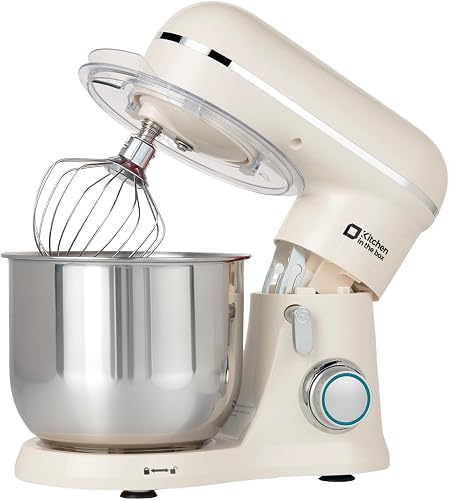
Kitchen in the Box 3.5-Qt
- 3.5-qt stainless steel bowl
- 300W motor and 10 speeds
- Dough hook, flat beater, whisk and splash guard
A compact choice for 1–2 people who bake modest amounts. Its low weight helps with moving it, and the bowl and mixing tools are dishwasher safe.
Pros
- Compact size and 5 lb weight
- 10 speed settings
- Dishwasher-safe bowl and mixing attachments
Cons
- Limited room for doubled recipes
- Smaller capacity than the family-size choices
Kitchen in the Box's 3.5-quart model suits 1–2 people who bake modest amounts. The brand gives examples of up to one loaf, two pizzas or 12 cupcakes, though your recipe's quantities still decide what fits.
The body weighs 5 lb and measures 11.5 x 7.28 x 10.8 in. That makes it worth considering if lifting and cupboard access are bigger concerns than having room for guests' baking.
Its 300W motor offers 10 speeds with planetary mixing action. You get the core mixing tools and a splash guard, with a dishwasher-safe stainless steel bowl and mixing attachments.
Choose this model when small batches are your normal routine rather than an occasional exception. It also leaves less appliance to move around a crowded counter when you're preparing pans and ingredients.
Skip it if you regularly double recipes or want to make several batches in one bowl. Dividing a recipe may solve a space problem, but repeated batches can turn a baking session into a much longer job.
Kitchen in the Box 3.2-Qt
- 3.2-qt stainless steel bowl
- 6 speeds
- Whisk, beater and dough hook
The lowest and narrowest body here suits restricted shelf space. Choose it for modest recipes when cupboard clearance matters more than extra bowl room.
Pros
- Low, narrow dimensions
- Tilt-head bowl access
- Three core mixing attachments included
Cons
- Smallest bowl in this group
- Not suited to large batches
The 3.2-quart Kitchen in the Box is the choice for a low, narrow cupboard opening. Its body measures 12.9 x 7 x 10.2 in, making it the lowest and narrowest machine in this group.
It isn't the shortest from front to back, so check shelf depth as well as height. At 7 lb, it also weighs more than the 3.5-quart version despite having a smaller bowl.
The set includes an aluminum dough hook and flat beater, plus a stainless steel whisk. You get 6 speeds, tilt-head access and a transparent anti-splash lid for modest daily recipes.
Choose it when those particular dimensions solve your storage problem. For working space, remember that the head must rise above the machine's closed height.
Skip it for large batches; Kitchen in the Box specifically advises against that use. If both compact models fit your shelf, the 3.5-quart version gives you a little more bowl room at a lower weight.
How these budget mixers compare
Compare capacity, working space and included tools before deciding which extras matter. We compared those features to match each machine with a baking routine, rather than ranking them by motor wattage alone.
A compact bowl can come in a relatively long body, while a larger bowl may add height rather than width. The table helps narrow the choice, but use the dimensions above to check your actual kitchen space.
| Product | Best for | Bowl | Speeds | Attachments | Our score |
|---|---|---|---|---|---|
| Aucma 6.5-Qt Tilt-Head | larger family recipes | 6.5 qt stainless steel | 6 plus pulse | Whisk, beater, dough hook | 7.8 |
| Vivohome 6-Qt Tilt-Head | varied family baking | 6 qt | 10 plus pulse | Whisk, hook, beater, egg separator | 7.7 |
| Hamilton Beach 4-Qt 7-Speed | frequent cupboard storage | 4 qt stainless steel | 7 | Whisk, flat beater, dough hook | 7.3 |
| Martha Stewart 5.3-Qt Tilt-Head | cake batter prep | 5.3 qt stainless steel | 12 | Whisk, dough hook, silicone-edge beater | 7.2 |
| Kitchen in the Box 3.5-Qt | small households | 3.5 qt | 10 | Dough hook, flat beater, whisk | 7.0 |
| Kitchen in the Box 3.2-Qt | low storage shelves | 3.2 qt stainless steel | 6 | Whisk, beater, dough hook | 6.9 |
How much bowl capacity do you need?
Choose enough room for your largest regular recipe, with space for ingredients to move. A bowl's full volume isn't a usable limit for batter or dough.
Write down the quantities in 2 or 3 recipes you make often. Compare those with the manual's limits, paying particular attention to flour and dough amounts rather than the number of finished cookies.
Cookie size varies, and a soft cake batter puts a different demand on the mixer than stiff dough. Claims about servings or batches are useful only when the recipe behind them resembles yours.
A small bowl makes sense when you're usually baking for yourself or a partner. Buying a large mixer for an annual celebration can leave you with an awkward machine for the rest of the year.
For frequent family baking, extra room can save you from dividing a recipe. Leave space for flour additions and for the mixture to rise up the sides as it moves.
Don't assume a large bowl will handle a very small quantity well. The whisk or beater needs to reach the ingredients, so check minimum quantities if whipping small amounts is a main task.
Our guide to choosing a stand mixer covers the wider decision. For help translating recipes into capacity, see what size stand mixer you need.
Which features deserve your budget?
Spend first on a usable bowl size, suitable attachments and a machine you can store comfortably. Extra controls are worthwhile when they make a regular recipe easier.
The best budget stand mixer controls for everyday baking
A low starting speed matters because it lets wet ingredients take in flour with less splatter. Start slowly, then increase only as the recipe requires.
More numbered settings give you more choices, but the count doesn't describe the actual speed of each step. You don't need a separate setting for every recipe in your cookbook.
Pulse can help with brief bursts of mixing, but it requires close attention. Stop as soon as the ingredients reach the right stage instead of using it as a substitute for watching texture.
Match the attachment to the mixture
Use the flat beater for many batters and cookie doughs, the whisk for cream and egg whites, and the dough hook for kneading. Check the recipe and manual when a mixture sits between those jobs.
An edge-style beater can reduce residue on the bowl wall, but inspect the bottom too. Stop the motor before scraping, and keep a spatula clear of moving attachments.
For thick cookie recipes, soften butter as directed rather than asking the machine to break up cold blocks. Our stand mixer guide for cookie dough covers that buying need in more detail.
Choose storage you can use comfortably
Measure the route from cupboard to counter, not just the empty shelf. A mixer that fits behind other heavy appliances may be inconvenient enough that you rarely use it.
If you're considering a KitchenAid instead, our guide on why KitchenAid mixers cost more explains which differences may matter to your baking routine.
Is a budget stand mixer enough for bread dough?
A budget mixer can suit occasional bread within its manual's limits. If stiff dough or repeated loaves are your main reason for buying, choose around those demands first.
All these picks include dough hooks, but a hook doesn't establish how much dough a machine can knead. Follow the specific model's speed, quantity, run-time and rest instructions.
Wattage describes electrical power use, not kneading strength by itself. Bowl capacity also tells you how much space is available, not how much resistance the drive can handle.
Hydration changes the job: a wetter dough moves differently from a stiff dough with less water. Don't add flour just to make dough look neat around the hook, since that can change the finished bread.
Stay close while kneading and watch for movement, stalling or unusual strain. Stop the mixer if it struggles, then reduce the load or finish by hand as appropriate.
Check dough development rather than relying only on elapsed time. The recipe's texture cues matter, and more mixing isn't always better.
Our guide to kneading dough with a stand mixer explains the process. It also helps you decide which parts of bread making benefit from a machine.
How should you set up a budget stand mixer?
Set the mixer on a level, dry counter with room to open the head fully. Keep it away from the counter edge and leave space beside it for ingredients and the removed bowl.
Before the first recipe, wash the removable food-contact parts as the manual directs. Dry them, then check that the bowl and chosen attachment are secured correctly.
With the mixer off and unplugged, check the attachment's position according to the instructions. It shouldn't strike the bowl, and you shouldn't borrow an adjustment method intended for another brand.
Read the speed guide before loading ingredients. Lock the head as directed, fit the splash guard if useful, and start at the recommended low setting.
For your first bake, choose a familiar recipe within the machine's capacity. A known recipe makes it easier to judge texture and timing without also learning an unfamiliar method.
Keep hair, clothing, utensils and hands clear during operation. Switch off and unplug before changing tools, removing trapped dough or reaching around the attachment joint.
How do you get better results without overworking the mixer?
Use the recipe's ingredient temperature, order and texture cues to guide mixing. Speed and time help, but they can't correct the wrong quantities or an overloaded bowl.
Weigh flour when the recipe gives weights. Scooping extra flour into a measuring cup can make a dough stiffer and place more demand on the machine.
Add dry ingredients in manageable portions at low speed. Give each addition time to combine before adding more, especially when the bowl is near its working limit.
Stop to scrape the sides and bottom between recipe stages. A smooth-looking surface can hide unmixed butter or flour beneath the beater's path.
Once flour goes into a cake batter, mix only as much as the recipe requires. Longer mixing can develop more gluten and change a tender cake's texture.
For cream and egg whites, watch the mixture closely as it thickens. A few extra moments can take it past the stage you wanted, so reduce speed or stop to check.
Avoid solving every problem with a higher setting. If ingredients aren't moving properly, stop and check the attachment, batch size and recipe before continuing.
How should you clean and store it?
Clean the bowl and tools soon after use, before batter and dough dry onto them. Unplug the base and wipe it with a damp cloth rather than immersing it.
Follow the manual for each removable part, even when some accessories are dishwasher safe. A safe method for one brand's whisk may not suit another brand's aluminum hook.
Remove stuck dough with a short soak if the care instructions allow it. Avoid scraping coated parts with sharp tools, which can damage their surfaces.
Wipe flour from seams and around the attachment area after each session. Dry everything fully before putting the tools away.
Store attachments where they won't rub or knock against each other. If you keep them inside the bowl, a clean cloth between parts can protect their surfaces.
Before moving the mixer, secure loose parts and follow the carrying instructions. Don't lift the whole appliance by its bowl or raised head.
Which budget stand mixer should you choose?
The best budget stand mixer is the one that fits your normal batch and kitchen space. Choose Aucma for larger family recipes, or Vivohome when varied baking makes its flex-edge beater and egg separator useful.
Pick Hamilton Beach if the carry handle solves a frequent storage chore. Choose Martha Stewart if cake batter preparation is your main task and you want its silicone-edge beater.
For a small household, start with the Kitchen in the Box 3.5-quart model. Pick the 3.2-quart version when its lower, narrower body fits a shelf the other machine won't.
Before ordering, check your largest regular recipe against the manual's limits and measure both storage and open-head clearance. If those checks leave you between sizes, our stand mixer buying guide can help settle the choice.
Our top 3 picks at a glance
-
1
-
2
-
3
Frequently asked questions
What should I look for in a budget stand mixer?
Choose a budget stand mixer around your usual recipe size, available storage and mixing tasks; check that it includes a beater for batter, a whisk for whipping and a hook if you make bread. Measure working clearance as well as cupboard space, especially above a raised tilt head.
Can a budget stand mixer knead bread dough?
Yes, a budget stand mixer can knead bread dough within its manual's limits for quantity, speed and run time; a larger bowl doesn't guarantee greater kneading strength, so match the machine to your recipe. Our guide to kneading dough with a stand mixer explains the process.
Is a compact stand mixer enough for one or two people?
Yes, a compact mixer can suit one or two people who make modest recipes; Kitchen in the Box describes its 3.5-quart model as suitable for up to one loaf, two pizzas or 12 cupcakes. Recipe size still matters, so choose more bowl room if you regularly bake for guests.
Should I choose a stand mixer or a hand mixer?
Choose a stand mixer when longer mixing steps or dough preparation are a regular part of your baking; a hand mixer suits occasional batter and whipped cream while taking less cupboard space. Our stand mixer vs hand mixer guide helps you choose around the recipes you actually make.