Stand Mixer vs Hand Mixer: Which Do You Need? (October 2026)
The stand mixer vs hand mixer choice comes down to your recipes: pick a hand mixer for small, quick batches or a stand mixer for regular bread dough and longer mixing jobs. Choose the style you'll comfortably set up, use and store.
On this page (11 sections)
- Stand mixer vs hand mixer: what changes in daily use?
- Which mixer fits cakes, cream, cookies and bread?
- Who should choose each hand mixer?
- Who should choose the Vivohome stand mixer?
- Which mixer handles thick dough better?
- How much space and bowl capacity do you need?
- How do you set up either mixer without making a mess?
- Which mistakes can spoil the result or strain the mixer?
- Which mixer is easier to clean and care for?
- Should you buy a hand mixer, a stand mixer or both?
- What settles the stand mixer vs hand mixer choice?
For stand mixer vs hand mixer, choose a handheld model for short mixing jobs and easy storage, or a stand mixer for regular kneading and longer batches. Your usual recipes matter more than how many speeds or accessories a mixer has.
A hand mixer moves between bowls and packs away after baking. A stand mixer supports its bowl and attachment, freeing your hands while you stay nearby and watch the mixture.
Neither style improves every recipe. A roomy stand mixer can be awkward for a tiny portion, while holding a hand mixer through a long mixing step can become tiring.

Stand mixer vs hand mixer: what changes in daily use?
The main difference is who supports and guides the tool. You move a hand mixer's beaters through your own bowl; a stand mixer moves its attachment through a bowl secured to the base.
With a handheld model, one hand holds the mixer and the other steadies the bowl. That gives you control over where the beaters go, but makes adding ingredients less convenient while it runs.
A stand mixer lets you measure the next ingredient while mixing continues. It still needs supervision, and you must stop it before scraping, reaching into the bowl or changing tools.
The time saved comes mostly from reducing the work you do during mixing. A stand mixer doesn't automatically shorten a recipe's mixing time, and either style can overmix batter.
Stand mixer or hand mixer: which is quicker to set up?
A hand mixer usually wins for a short job, especially if both appliances live in a cupboard. Attach the beaters, choose a suitable bowl and you're ready to mix.
A stand mixer left on the counter can be just as convenient for frequent baking. If you must carry it out and clear a space each time, that extra work can outweigh its help with a quick frosting.
Think through the whole routine, including putting it away. Our guide to small and compact stand mixers helps if a full-size appliance would crowd your workspace.
Which mixer fits cakes, cream, cookies and bread?
Choose by the mixture and the time it needs, rather than treating one style as better at everything. Light mixtures suit either style, while kneading calls for suitable dough equipment.
| Your usual job | Practical starting choice | What matters most |
|---|---|---|
| Whipped cream or frosting | Hand mixer | A suitable bowl and close attention near the finish |
| Occasional cakes | Hand mixer | Enough bowl space to add ingredients without splashing |
| Repeated cake batches | Stand mixer | Less time holding the tool through each batch |
| Soft cookie dough | Either style | Dough stiffness and the model's batch limits |
| Bread dough | Stand mixer with dough hook | Approved dough load, speed and run time |
| Tiny mixtures | Hand mixer or manual whisk | Whether the beaters can reach the ingredients |
For cakes, a stand mixer helps with longer butter-and-sugar creaming steps. Once flour goes in, either style needs restraint because extra mixing can make some cakes tough.
Cream and egg whites change quickly near the end of whipping. Watch their texture rather than leaving the mixer running for a fixed extra minute.
For cookies, a small, soft dough is a different job from a large batch packed with oats and nuts. If cookies dominate your baking, choose for the thickest dough you regularly make.
Who should choose each hand mixer?
Choose a hand mixer for occasional baking and flexible bowl use. Skip these handheld models if your main aim is bread kneading or avoiding the need to hold a mixer.
KitchenAid KHM512: for short, everyday mixing
The KitchenAid KHM512 suits occasional cakes, frosting and suitable cookie dough. Its 5 speeds cover gradual combining through whipping, and the lockable swivel cord helps keep the cable away from your working hand.
It comes with 2 stainless steel Turbo Beater accessories. A single-handed release button lets you remove them after switching off and unplugging.
This is a straightforward choice if you already have mixing bowls and want a compact appliance. You aren't paying for a countertop bowl system that you'll rarely use.
Skip it if holding a mixer is uncomfortable or if you need a dough hook. A compact body still requires you to support and guide it throughout the mixing step.
Hamilton Beach: for keeping the mixing kit together
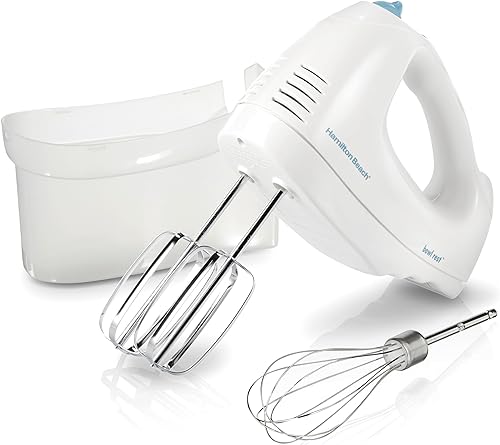
The Hamilton Beach suits bakers who want attachments stored with the mixer. Its snap-on case keeps the tools together, which is useful if loose beaters tend to disappear into a crowded drawer.
It includes 2 traditional beaters and a separate whisk, with 6 speeds plus QuickBurst. The Bowl Rest feature supports the mixer on a bowl edge during a pause.
Use Bowl Rest with the motor stopped and the bowl stable. It provides somewhere to set the mixer briefly, rather than turning it into a stand mixer.
Choose it for the organized kit and separate whisk. Skip it if you're buying mainly to handle heavy dough, since the included tools don't include a dough hook.
Who should choose the Vivohome stand mixer?
The Vivohome suits regular baking when you want a supported bowl and a dough hook. It's the stand mixer option here for moving beyond handheld mixing into machine kneading.
Its 6 qt bowl comes with a whisk, beater, dough hook and egg separator. The controls offer 10 speeds plus pulse, and the tilt head opens access for fitting tools and adding ingredients.
Choose it if you make repeated batches or want to stop holding a mixer through longer steps. That benefit is strongest when the appliance can stay somewhere convenient.
Skip it if you mainly whip a small serving of cream or have no clear place to use it. A larger bowl can be less useful when a small quantity sits below the attachment's effective reach.
For bread, follow VIVOHOME's dough instructions rather than treating bowl volume as a kneading allowance. Our guide on how to knead dough with a stand mixer explains the process.
Which mixer handles thick dough better?
A stand mixer approved for the dough you're making is the better machine-kneading choice. Neither hand mixer here includes dough hooks, so don't use its beaters as a substitute.
Bread dough resists the tool differently from cake batter. A dough hook works the dough, while beaters are intended for other mixing jobs.
Capacity needs a separate check for each dough type. A bowl that holds a large amount of batter may have a much lower limit for stiff bread dough.
Don't add extra flour just because dough looks sticky early in kneading. Some doughs become smoother as they develop, and excess flour can produce a dry loaf.
Stop if the mixer struggles, shifts or shows signs of overheating. Reducing the load is more useful than increasing speed to force the attachment through it.
Our guide to stand mixers for home bakers covers the broader choices. For regular bread making, use the bread dough stand mixer guide to narrow the field.
How much space and bowl capacity do you need?
Plan for working space, storage space and access above the appliance. A mixer fitting on a shelf doesn't mean you can comfortably operate it there.
The KitchenAid handheld body measures 8 in deep, 3.5 in wide and 6 in high. Leave storage room for its loose accessories as well as the mixer.
The Vivohome measures 15.2 in deep, 8.8 in wide and 18.8 in high. Allow extra clearance to raise the head, fit attachments and remove the bowl.
Also leave space beside the mixer for ingredients and a spatula. A base squeezed between appliances may fit physically while making each recipe awkward.
Choose bowl capacity around your normal recipe, not the largest batch you might make once. Our guide to what size stand mixer you need explains how to think about batch size.
How do you set up either mixer without making a mess?
Start with a stable bowl, the correct attachment and low speed. Good setup prevents splashes and reduces the need to stop midway through a recipe.
For a hand mixer, choose a bowl deep enough to contain the beaters and mixture with room above them. A nonslip mat can help keep the bowl steady while your other hand supports it.
Fit the attachments with the appliance unplugged, then lower them into the ingredients before starting. Turn the mixer off before lifting the beaters out so batter stays in the bowl.
For a stand mixer, secure the bowl and attachment as the manual directs. Close and lock the head where required, then check that the cord and nearby utensils are clear.
Match the attachment to the task: a whisk for aeration, a beater for many batters and frostings, and a suitable hook for kneading. Use the model's speed guidance for each tool.
Add dry ingredients at low speed, preferably in portions if the recipe allows. Stop and scrape the bowl as needed, even when a mixer has features intended to reduce scraping.
Which mistakes can spoil the result or strain the mixer?
Avoid forcing cold ingredients, oversized batches and unsuitable attachments. These problems matter more than having an extra speed setting.
Butter meant to be softened should yield when pressed without being melted or greasy. Trying to cream hard chunks makes mixing harder and can leave an uneven mixture.
Don't use high speed to solve every slow mixing step. It can throw flour out of the bowl, overwhip cream or work a dough beyond the appliance's recommended speed.
More wattage or more speeds doesn't prove a mixer can knead more dough. Look at approved uses and batch limits, since motor figures alone don't describe the whole appliance.
Watch the food as well as the clock. Stop whipping when the recipe's texture is reached, and stop mixing batter once its ingredients are combined as directed.
Finally, use a spatula for folding when a recipe calls for it. Keeping air in a delicate mixture or adding bulky pieces may call for a gentler approach than powered mixing.
Which mixer is easier to clean and care for?
A hand mixer generally leaves fewer appliance parts to wash, but both styles need prompt cleanup. You'll still clean a bowl, attachments and any splashes around the work area.
Both handheld models have dishwasher-safe mixing attachments. Check the care instructions for each stand mixer part before choosing a wash method.
Unplug before removing attachments or wiping the body. Keep the motor housing out of water, and use a damp cloth rather than soaking it or rinsing it under a faucet.
Remove batter before it dries around attachment joints and bowl edges. Dry the tools fully before storing them, especially inside a closed storage case.
Leave clearance around the appliance during use and keep ventilation openings free of flour buildup. Follow the manual's run-time and cooling guidance rather than assuming any mixer can run continuously.
Should you buy a hand mixer, a stand mixer or both?
Buy one mixer for your most common job first. Add a second only when it solves a separate, repeated need.
A hand mixer is enough for many occasional bakers. If your baking calendar consists of a few cakes, whipped toppings and holiday cookies, easy storage may matter more than a supported bowl.
A stand mixer earns its space through repeated use. Bread kneading and long creaming steps offer clearer reasons to buy one than simply wanting more speed settings.
Owning both can help when a recipe needs dough in one bowl and frosting in another. It also means storing and caring for another appliance, so wait until that second job becomes routine.
Read is a stand mixer worth it for home baking? if you're weighing the commitment. For countertop options, compare our best budget stand mixers.
If you're considering a different brand or style, KitchenAid's stand mixer range shows its current options. Our guide on how to choose a stand mixer helps you match features to recipes.
What settles the stand mixer vs hand mixer choice?
Settle stand mixer vs hand mixer by naming the task you want to make easier. Choose KitchenAid for a compact everyday handheld, Hamilton Beach for a kit that stores together, or Vivohome for supported mixing and suitable bread dough.
Before ordering, choose a storage spot and check the instructions against a recipe you already make. For a stand mixer, our guide to what you can make with a stand mixer can help you plan uses beyond the first loaf.
Frequently asked questions
Is a stand mixer better than a hand mixer?
A stand mixer is better for regular kneading and longer mixing jobs, while a hand mixer suits short tasks and easy storage. For cakes, cream and many cookie recipes, either style can work; choose around your usual batch size, available space and comfort holding a running mixer.
Can a hand mixer knead bread dough?
Neither hand mixer here includes dough hooks, so choose the stand mixer for machine kneading. Some other hand mixers accept dough tools, but that doesn't make all models suitable for bread; follow the specific appliance's instructions for dough type, batch size, speed and run time.
Can you use a hand mixer for cookie dough?
Yes, both hand mixers here support cookie dough mixing within their limits. Start with properly softened butter when the recipe calls for it, add flour at low speed and fold in bulky additions by hand if needed; stop if the beaters slow sharply or the mixer struggles.
Which mixer is easier to clean?
A hand mixer usually has fewer appliance parts to clean, though you still need to wash your bowl; both hand mixers here have dishwasher-safe mixing attachments. Unplug before removing tools, wipe the motor housing with a damp cloth and follow each part's care instructions before machine washing.
Do you need both a stand mixer and a hand mixer?
You don't need both unless they solve different jobs in your kitchen. A frequent baker might use a stand mixer for dough and a hand mixer for a separate frosting or filling; occasional bakers can usually start with one appliance that handles their most common recipes.


